Chord Geometry
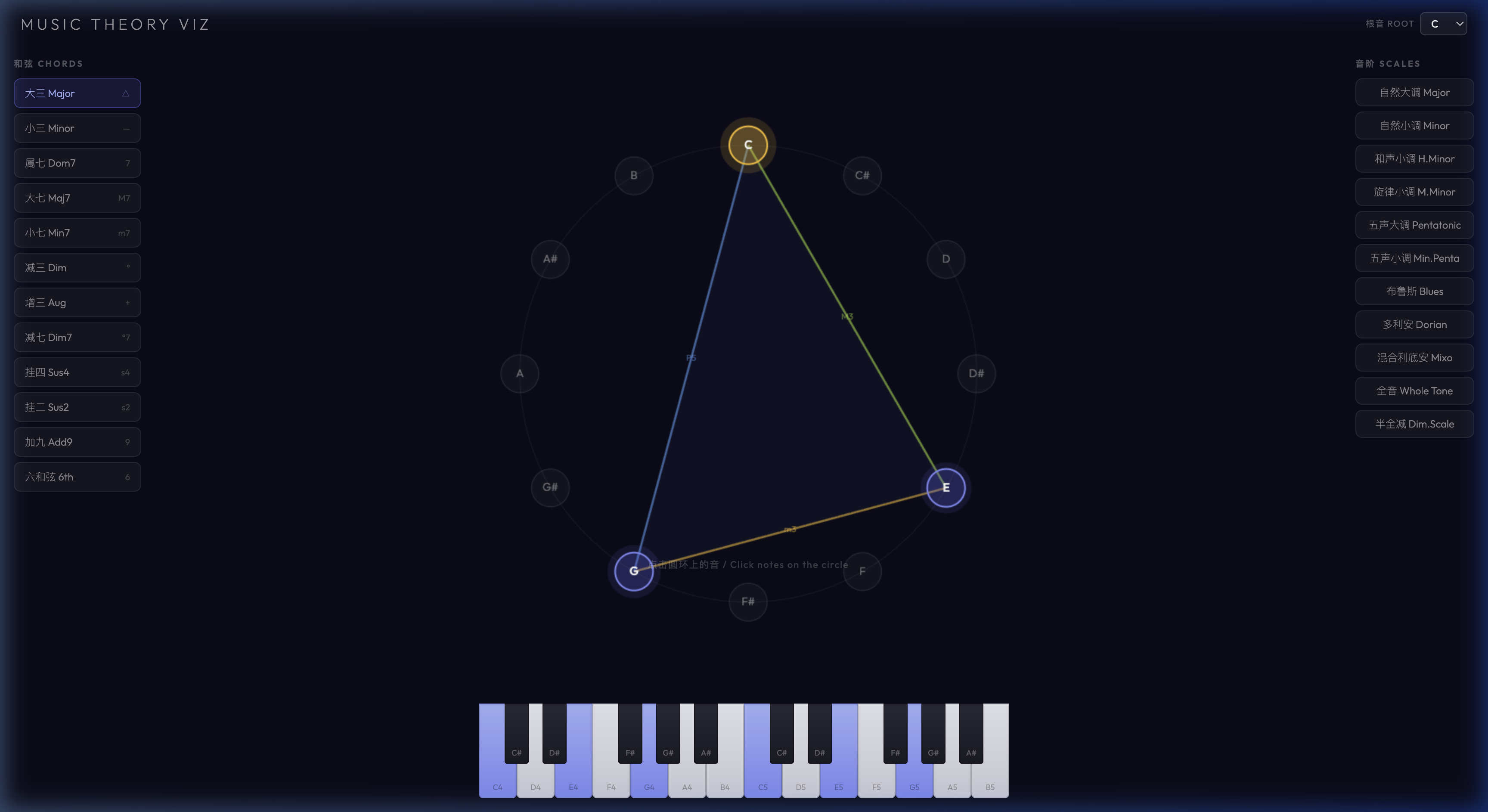
A chord is not an abstract concept - it is a geometric shape. Twelve notes sit evenly on a circle: a triangle is a major triad, an inverted triangle a minor, a quadrilateral a dominant seventh. Music's secret was written in mathematics all along.
About This Work
Pythagoras discovered the relationship between intervals and mathematical ratios. Twenty-five hundred years later, Chord Geometry lets you see this discovery's shape. Twelve notes are distributed evenly around a circle like hours on a clock face. Select a chord and connecting lines appear automatically - a major triad forms an isosceles triangle, a minor triad its mirror image, a dominant seventh an irregular quadrilateral. Every chord has its unique geometric signature. Click the keyboard below and the chord sounds instantly. The shape you see is the harmony you hear.
Features
- Twelve-tone interval circle visualization
- Chord geometry display (major/minor/dominant 7th)
- Clickable piano keyboard with instant sound
- Scale highlighting
- Chord construction principle teaching
How to Use
- Click notes on circle to see intervals
- Select chord type to view geometric connections
- Click piano keys to hear notes and chords
- Switch modes to see scale structures
- Hover notes for detailed music theory info