Roots of Time
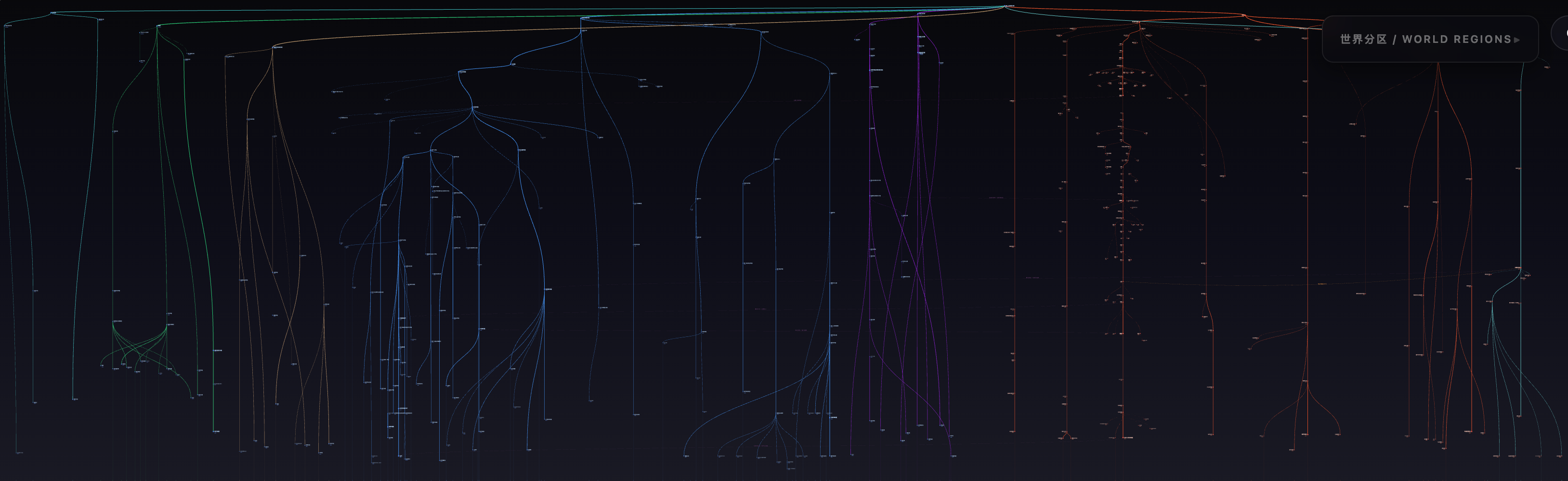
Visualizing the epic of human civilization across 7 global cultural zones through a 3D neural network, featuring an embedded interactive micro-encyclopedia of historical emperors.
About This Work
Time is not a unidirectional scale, but intertwines like plant roots in the dark. As a comprehensive data history, Roots of Time reconstructs the rise and fall of global cultural spheres—China, Japan, Mughal, Persia, Europe, and Americas—into Minimal Lineage, Fractal Scroll, and a stunning 3D Neural Network. Furthermore, it embeds a custom micro-encyclopedia engine fetching life descriptions of hundreds of emperors. By clicking any emperor card, an elegant frosted-glass drawer reveals their legacy. Here, between macro-civilization fractals and micro-individual destinies, time gains a living, holographic museum. This is the work I spent the most time on — it grew from a fixation I've carried for years: why does human history always repeat itself? Dynastic cycles, the rise and fall of empires, the recurring patterns of governance and collapse — history seems to tell the same story wearing different masks. Roots of Time is my attempt to make that curiosity tangible. ⚠️ The dataset was compiled with the assistance of an LLM. Given the inherent limitations of training data and model knowledge cutoffs, historical inaccuracies may exist. If you spot any errors, please feel free to reach out at mulinux@icloud.com — your corrections are sincerely welcome.
Features
- Ancient tree-like historical architecture connecting 7 global civilization zones
- Naturally growing classical timelines based on fractal geometry laws
- Holographic, free-roaming brilliant star-river history network suspended in deep space
- Embedded interactive micro-encyclopedia chronicling the lives of hundreds of legendary emperors
How to Use
- Use the bottom UI panel to switch between 2D timeline and 3D neural networks freely.
- Use the mouse wheel to explore global civilization branches and historical years.
- Click on any emperor card in timeline or 3D mode to bring up their detailed micro-biography drawer.